
No products in the basket.
Industrial Anti-Slip Safety, Stair Safety & Compliance
Are Stair Nosings a Legal Requirement? Part K & M Explained
22
May
May
If you manage a workplace, school, public building or rented property, you are responsible for keeping stairs safe. A question we are often asked is whether anti-slip stair nosings are a legal requirement. The short answer: while the regulations rarely name stair nosings directly, the duties they place on you make slip-resistant, visually contrasting step edges effectively essential.
What the Building Regulations say
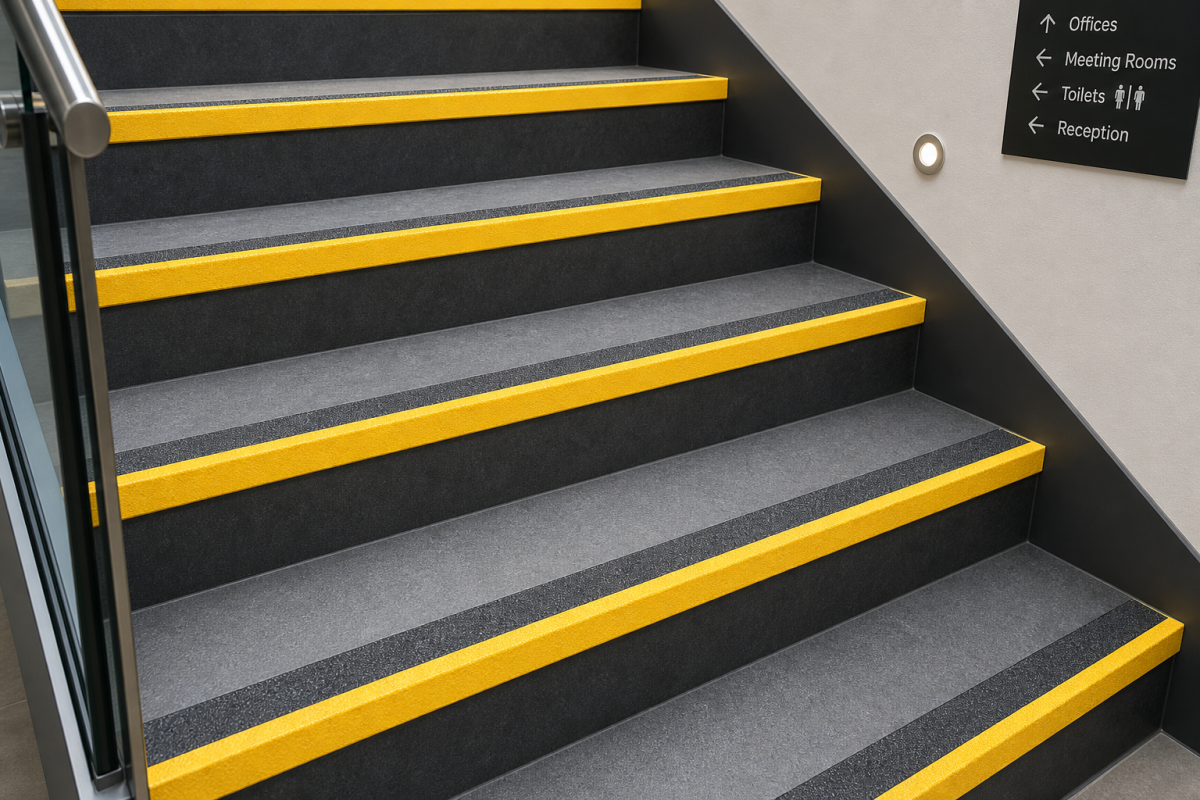
In England and Wales, stairs are covered by Approved Document K (protection from falling, collision and impact) and Approved Document M (access to and use of buildings). Approved Document M states that, in buildings other than dwellings, step nosings should be made visually apparent using a material that contrasts visually, a minimum of 55mm wide on both the tread and the riser. In common areas of buildings containing flats, the guidance is 50 to 65mm on the tread and 30 to 55mm on the riser.How much contrast is enough?
BS 8300-2:2018, the accessibility standard referenced by Part M, defines adequate visual contrast as a difference of at least 30 points on the Light Reflectance Value (LRV) scale between the nosing and the surrounding step. LRV runs from 0 (black) to 100 (white), so a bigger difference makes each step easier to see.Workplace health and safety duties
Separately, the Health and Safety at Work etc. Act 1974 and the Workplace (Health, Safety and Welfare) Regulations 1992 require employers and those in control of premises to keep floors and traffic routes, including stairs, free from slip and trip risks. The HSE records slips and trips as the most common cause of major workplace injury, so a slippery or hard-to-see step edge is a clear liability.How to meet the requirements
Anti-slip stair nosings address both points at once: a gritted, slip-resistant surface for grip and a high-contrast colour to make each step visible. Our GRP stair nosings come in profiles such as 55 x 55mm and 70 x 30mm in yellow, black and grey, and can be cut to size. For worn or uneven steps, full-width GRP stair tread covers with a contrasting nose restore grip and visibility in a single fitting.In summary
No single rule says you must fit stair nosings, but the combination of Building Regulations, accessibility standards and health and safety law makes slip-resistant, visually contrasting step edges the practical way to comply and to protect the people using your stairs.This guide is general information, not legal advice. Always check the current Approved Documents and take professional advice for your building.Related products and guides
- Browse our anti-slip GRP stair nosings, cut to size in Part K compliant colours
- See GRP stair nosing prices and colour options
- Guide: DDA, contrast nosings and the Equality Act
- Guide: When should stair nosings be replaced?
- Guide: Stair tread covers vs stair nosings: which do you need?
Specifying a nosing? Our full guide to UK stair nosing regulations quotes Approved Document K and Approved Document M paragraph by paragraph, and covers the 30 point LRV contrast rule, pendulum test values and how to write a compliant specification.