
No products in the basket.
Industrial Anti-Slip Safety, Stair Safety & Compliance
DDA & Stair Safety: Contrast Nosings and the Equality Act
22
May
May
Many businesses still talk about DDA compliance for stairs. In practice, the Disability Discrimination Act was replaced in Great Britain by the Equality Act 2010, which carries the same goal forward: making buildings usable by disabled people, including those with limited vision. Clear, slip-resistant stair edges are central to that.
From the DDA to the Equality Act 2010
The Equality Act places a duty on service providers and employers to make reasonable adjustments so disabled people are not put at a substantial disadvantage. For stairs, that means steps a partially sighted person can see and a surface that is safe underfoot in all conditions.What good practice looks like
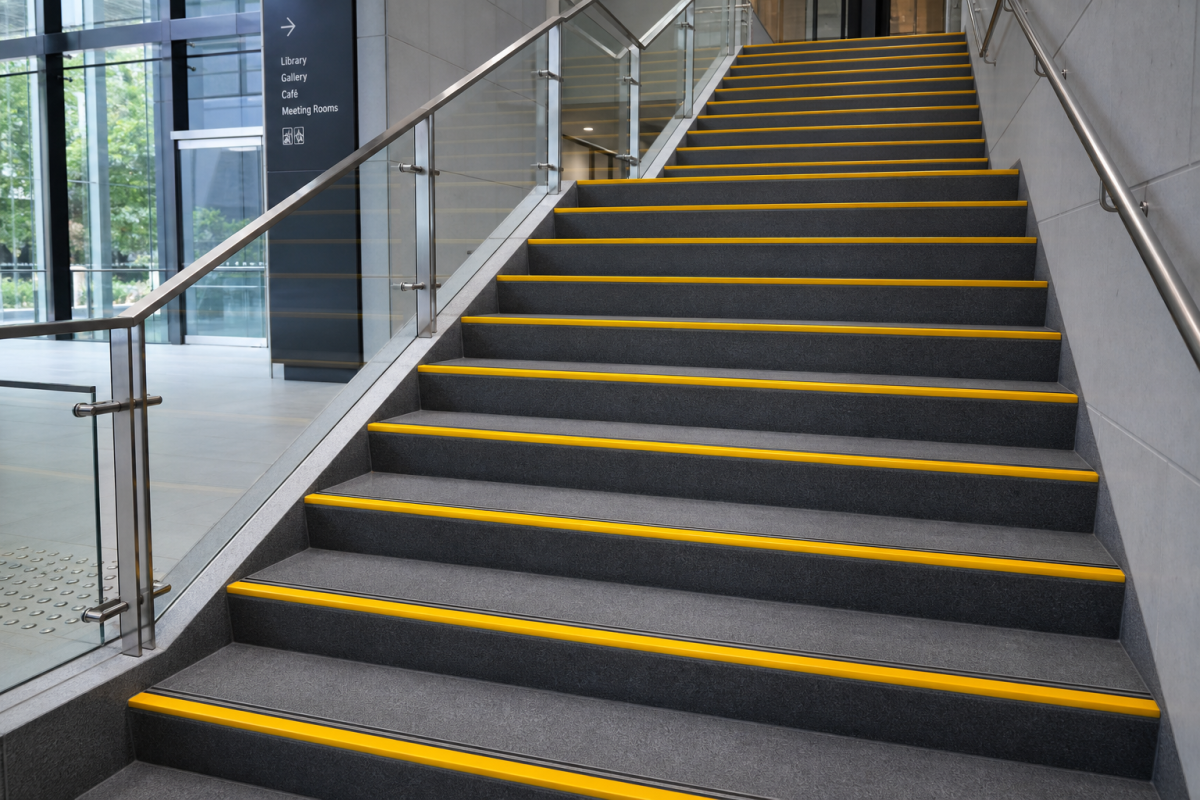
BS 8300-2:2018, the leading accessibility design standard, recommends that step nosings contrast visually with the rest of the step by at least 30 points on the Light Reflectance Value (LRV) scale. Building Regulations Approved Document M asks for a contrasting strip a minimum of 55mm wide on the tread and riser in buildings other than dwellings. A dark tread with a bright yellow or white nose is the classic, effective combination.Grip matters too
Visibility is only half the picture. The Health and Safety Executive treats slips and trips as the biggest cause of major workplace injury, so step edges also need a slip-resistant surface that performs when wet.A simple, compliant solution
Anti-slip nosings and tread covers deliver both contrast and grip together. Our GRP stair tread covers are available with a contrasting nose and a gritted anti-slip surface, ideal for high-traffic public stairs. For step edges alone, our GRP stair nosings come in high-visibility colours and can be cut to size.This guide is general information, not legal advice. Take professional advice on your accessibility obligations.Related products and guides
- Browse our anti-slip GRP stair nosings, cut to size in Part K compliant colours
- Browse our GRP GLOW photoluminescent stair nosings for emergency escape routes
- Guide: Are stair nosings a legal requirement? Part K and M explained