
No products in the basket.
Industrial Anti-Slip Safety
Why Tradespeople Are Switching to GRP Decking Boards: The Anti-Slip Solution That Lasts
09
Apr
Apr
If you’ve ever been called back to a job because a timber deck has turned into an ice rink after six months of British weather, you already know the problem. Traditional softwood decking looks fine on day one, but it doesn’t take long for algae, moisture and general wear to turn it into a slip hazard — and a liability headache for you and your client.
That’s exactly why more contractors, landscapers and maintenance teams across the UK are specifying GRP decking boards as a long-term, anti-slip alternative to timber.
Safety Products Direct supplies anti-slip and safety products to tradespeople, contractors and facilities managers across the UK. Fast dispatch, trade pricing, and expert advice as standard.
What Are GRP Decking Boards?
GRP stands for Glass Reinforced Plastic — a composite material made from polyester resin reinforced with glass fibres. In decking form, the boards feature a heavy-duty anti-slip grit surface that’s moulded directly into the material during manufacture, not simply glued or coated on top. The result is a non-slip decking board that maintains its grip in wet, frosty, and even oily conditions — the exact environments where timber decking fails.Why Contractors Are Choosing GRP Over Timber
Proven Anti-Slip Performance
Standard timber decking becomes dangerously slippery when wet. GRP anti-slip decking boards typically achieve a Pendulum Test Value (PTV) of around 70 dry and 65 wet — well above the 36 PTV threshold that classifies a surface as low slip risk. For any project where safety is a priority — schools, care homes, public walkways, hospitality venues — this matters.No Rot, No Warp, No Ongoing Maintenance
Timber decking demands regular treatment: sanding, oiling, replacing boards that have split or rotted through. GRP structural decking is impervious to moisture, won’t rot, and resists UV degradation. Many GRP boards carry a 10-year guarantee, and in practice they last far longer. For your clients, that means lower total cost of ownership. For you, it means fewer warranty callbacks.Lightweight and Quick to Install
Despite their strength, GRP decking boards are significantly lighter than hardwood equivalents. They can be cut with standard tools and fixed directly to timber or metal subframes. A faster installation means you can complete more jobs and improve your margins — without compromising on quality.Built for Heavy-Duty Use
GRP structural decking boards are engineered to handle high foot traffic, heavy loads and impact. They’re commonly specified for commercial walkways, marina pontoons, balconies, ramps, fire escapes and roof terraces — environments that would destroy conventional decking within a few seasons.GRP Decking Boards vs. Anti-Slip Decking Strips: Which Do You Need?
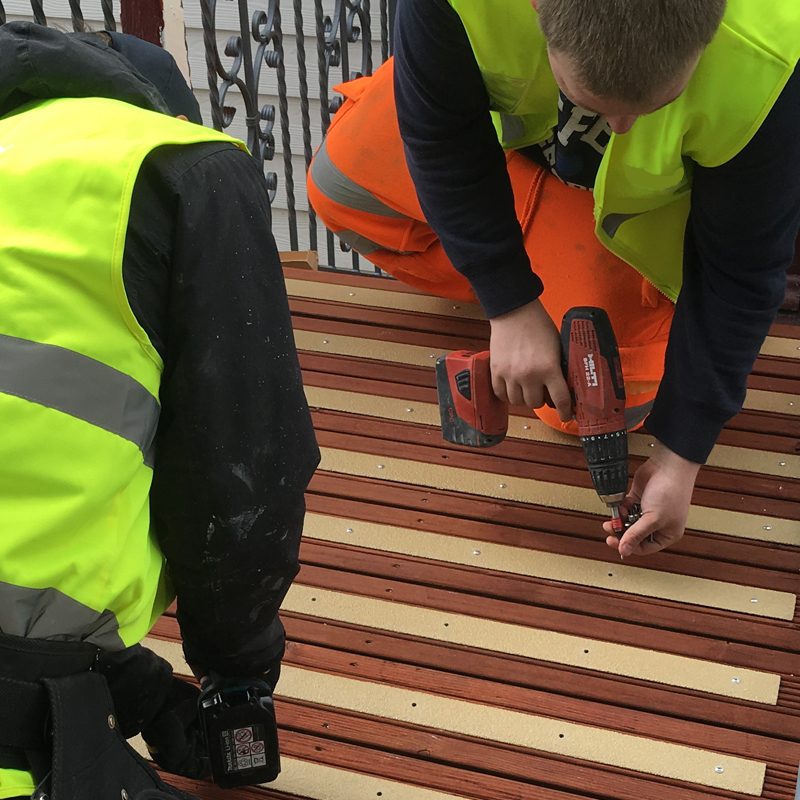
If you’re working on a new build or full deck replacement, GRP structural decking boards are the most effective solution. They replace timber boards entirely, giving you a consistently anti-slip surface across the whole deck area. For retrofit projects — where the existing timber substructure is still sound but the surface has become slippery — GRP anti-slip decking strips offer a cost-effective upgrade. These strips bond or screw directly onto existing boards, adding reliable grip without the need for a full rebuild. Both approaches deliver a dramatic improvement in slip resistance compared to untreated timber, and both options are available in a range of sizes and colours to suit the project.Where GRP Decking Performs Best
GRP decking is specified across a wide range of commercial, industrial and residential applications, including:- Garden decking and patios (particularly north-facing or shaded areas prone to algae)
- School and nursery outdoor areas
- Care home walkways and ramps
- Pub and restaurant terraces
- Marina walkways and pontoons
- Fire escape routes and access platforms
- Balconies and roof terraces
- Public footpaths and boardwalks
What to Look for When Specifying GRP Decking
Not all GRP decking products are created equal. When choosing boards for a project, check for:- PTV rating — look for tested slip resistance values, not just marketing claims
- Load capacity — structural boards should be rated for the expected foot traffic and load
- Grit bonding method — surface grit moulded during manufacture lasts far longer than adhesive-applied grit
- Guarantee length — reputable suppliers back their boards with a meaningful warranty
- Fire rating — important for commercial and public access projects
- Colour options — clients increasingly expect a choice beyond standard grey or green
Get the Right Anti-Slip Decking for Your Next Project
At Safety Products Direct, we stock a full range of GRP decking boards, anti-slip decking strips, and stair nosings — all designed to eliminate slip hazards and reduce long-term maintenance costs. Whether you’re pricing a new commercial walkway or retrofitting grip to an existing residential deck, we can help you find the right product for the job. Browse our full anti-slip decking range or get in touch for advice on specification and bulk pricing.Safety Products Direct supplies anti-slip and safety products to tradespeople, contractors and facilities managers across the UK. Fast dispatch, trade pricing, and expert advice as standard.
Related products and guides
- Browse our anti-slip decking strips that screw straight onto existing boards
- Guide: How to stop decking being slippery
- Guide: Slip ratings explained: PTV and R values